Global-to-local Water Cycle Monitoring
Tracking freshwater changes using satellite and in situ observations and physics-based and AI/ML models
The water cycle undergoes annual and year-to-year changes naturally. However, humans have been making substantial changes to it indirectly through climate change, and directly through interventions such as dam building, land use changes, and groundwater withdrawals. These changes are quite rapid and have accelerated in recent years, as we showed in our 2025 Science Advances study. They have tremendous implications on other climate systems such as the sea level, as well as socio-ecological and economic systems, as we showed in the flagship World Bank report 'Continental Drying'.
However, the current monitoring systems have several challenges, including different spatial and temporal resolutions, discontinuities in data coverage, and lack of integration with other monitoring systems.
What we're doing:
We are building a near-real-time, global-to-local water cycle monitoring system that addresses these issues and provides a unified view of freshwater availability across the globe.
This involves:
- Investigating satellite observations of critical water cycle variables such as mass changes, precipitation, soil moisture, and snow water equivalent from multiple satellite observations
- Combining these with locally accurate but sparse and discontinuous field observations
- Regularizing and harmonizing these data with physics- and AI/ML- based models to provide a continuous, high-resolution, near-real-time state of the water cycle
- Developing open source and open access reproducible pipelines that any research organization can adopt
- Identifying regions approaching critical freshwater thresholds, particularly in dryland and heavily irrigated basins
- Connecting global-scale drying trends to local water supply and ecosystem vulnerability
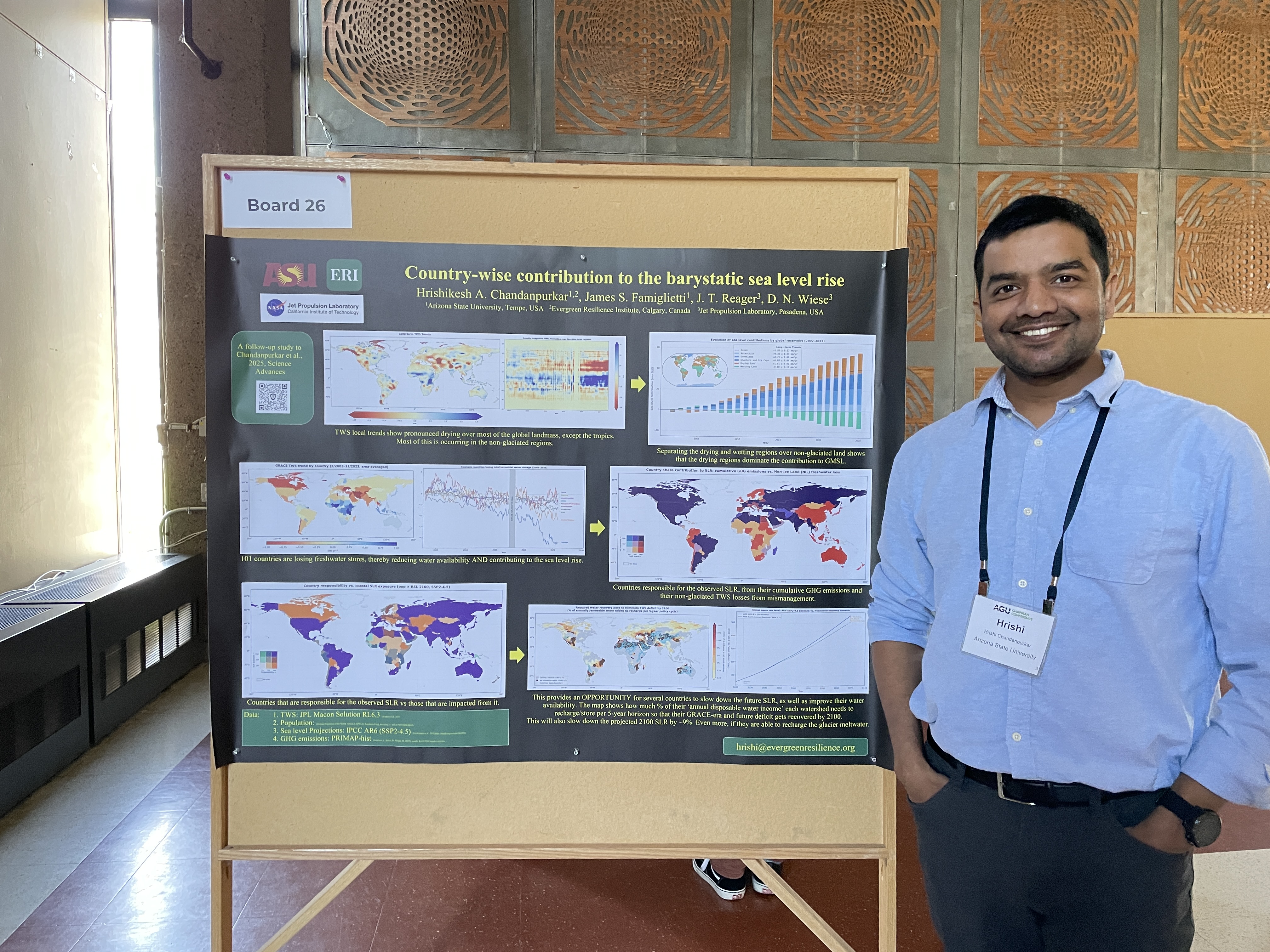
Presenting at the AGU Chapman Conference on Updating Usable Projections of Future Sea Level, Montreal, QC, Canada, 8-11 June 2026
Chandanpurkar, H.A., Famiglietti, J.S., Gopalan, K., Wiese, D.N., Wada, Y., Kakinuma, K., Reager, J.T., Zhang, F.
Unprecedented continental drying, shrinking freshwater availability, and increasing land contributions to sea level rise
Science Advances, 11, eadx0298
Zhang, F., Borja-Vega, C., Chandanpurkar, H.A., et al.
Continental Drying: A Threat to Our Common Future
World Bank Policy Report
Rohde, M., ... Chandanpurkar, H.A., ... et al.
Groundwater-dependent ecosystem map exposes global dryland protection needs
Nature, 632, 101–107
Project Leads
Hrishi Chandanpurkar
Collaborate
Interested in contributing to this project? We welcome researchers, community partners, and funders.
Get in TouchCollaborate with us
We welcome collaborations with researchers, communities, funding agencies, and organizations working on climate resilience, water systems, and food security.
General Inquiries
info@evergreenresilience.org
Director of Science
hrishi@evergreenresilience.org
Director of Policy & Engagement
juhi@evergreenresilience.org